Des Moines History Timeline 1920-1929





Des Moines History Timeline
1700-1849 | 1850-1869 | 1870 | 1880 | 1890 | 1900 | 1910 | 1920 | 1930 | 1940 | 1950 | 1960 | 1970 | 1980 | 1990 | 2000 | 2010 | 20201920's
- Campfire group organized by Mrs. Mark VanGasken in Des Moines.
1921
- A dance hall was established at Star Lake. Previously the Star Lake Inn and Three Sister's Inn existed there.
- Weston Betts purchased a carousel (which in 1977 was moved to Enchanted Village in Federal Way after having been in Tacoma) along with constructing a dance hall at Redondo in 1922. The Dance Hall was converted into a skating rink in 1937 called the "Redondo Amusedrom." It was destroyed by fire on January 20, 1951. In 1962 the Betts family built the Bayshore Apartments on the site of the skating rink.
1922
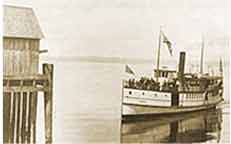
- March 9 - The Mosquito Fleet steamer Virginia V was launched at Maplewood, Pierce County. The vessel would become one of Puget Sound's best-known passenger steamers and is today the last operational example of the region's historic Mosquito Fleet.
- November 11 - On Armistice Day, the first of 25 memorial elm trees were planted along High Line Road (Des Moines Way later renamed Des Moines Memorial Drive in 1984) by the Seattle Garden Club under the leadership of Lillian Gustin McEwan. The project became a "Living Road of Remembrance" honoring Washington's World War I dead. Eventually 1,432 American elms were planted along the route from South Park in Seattle and the Kent-Des Moines Road. Age and Dutch Elm disease have taken their toll on many of these trees.
1924
- March 17 - Boy Scout Troop 375 was formed by Reverend Beatty, Rollin Case, and Franklin Lowery.
- September 4 - Highline High School opened as Union R High School District No. 41's new junior-senior high school. Serving students from Des Moines, Burien, White Center, and surrounding communities, it became the first public high school serving much of the Highline area.
- November 11 - On Armistice Day, the first of 25 memorial elm trees were planted along High Line Road (Des Moines Way later renamed Des Moines Memorial Drive in 1984) by the Seattle Garden Club under the leadership of Lillian Gustin McEwan. The project became a "Living Road of Remembrance" honoring Washington's World War I dead. Eventually 1,432 American elms were planted along the route from South Park in Seattle and the Kent-Des Moines Road. Age and Dutch Elm disease have taken their toll on many of these trees.
- November 26 - At 2:00 AM on Thanksgiving morning federal prohibition agents arrested nine men, including Roy Olmstead known on the West Coast as "the Good Bootlegger". Olmstead did not dilute his liquor with water or chemicals. He did not allow his employees to carry firearms, telling his men he would rather lose a shipment of liquor than a life. Federal agents seized five automobiles; a King County Sheriff's squad car; rumrunning launch No. M222, known as the Three Deuces; and 240 cases of contraband liquor at the Woodmont dock in Des Moines. Olmstead was sentenced to four years with hard labor and fined $8,000. He was granted a full presidential pardon by President Franklin D. Roosevelt on December 25, 1935.
- Gilbert Road (South Star Lake Road) from Military Road to SR 99 constructed.
1925
- January 9 - At 9 p.m. local time, the Des Moines Elementary School, a two-story wood frame building, was destroyed by fire. At the time, it was the only school in Des Moines. Its enrollment was more than 100 pupils.
1926
- The Redondo Heights Grocery opened at 27905 Pacific Highway South. Built as the first grocery store between Seattle and Tacoma on the new Federal Highway, it became one of the earliest commercial businesses serving the developing Redondo Heights community. It was demolished in 2025.
- April 24 - Saltwater State Park was dedicated before a crowd of approximately 5,000 people. Governor Roland H. Hartley, Seattle Mayor Edwin J. Brown, Tacoma Mayor Angelo V. Fawcett, and Seattle Mayor-elect Bertha Landes participated in ceremonies that included burying a hatchet beneath a hawthorn tree to symbolize peace and cooperation between Seattle and Tacoma.
1927
- June 21 - The Masonic Home of Washington is dedicated in Zenith. Constructed on a bluff overlooking Puget Sound, the five-story retirement home for Washington Masons became one of the most recognizable landmarks between Seattle and Tacoma. The Masonic Home has been a prominent landmark along Marine View Drive South for nearly a century, visible from as far as Tacoma. Locals remember it as a "castle on the hill," a venue for weddings, festivals, and community events, and a scenic site with 30 acres of grounds offering views of Maury Island and the Olympic Mountains. Its preservation is seen as vital to maintaining the historical character and heritage of Des Moines, Washington.
1928
- April 25 — The Des Moines–Zenith Orthopedic Auxiliary was organized to support Seattle's Orthopedic Hospital and its work caring for children with physical disabilities. The auxiliary became one of many volunteer organizations serving the Des Moines and Zenith communities during the late 1920s.
- October 18 - Completion and opening of the paved highway that became US 99 and transformed development in the Des Moines/Federal Way area.
- The Seattle-Tacoma Land Company was organized to develop Normandy Park, a planned residential community on 1,200 acres of Puget Sound shoreline between Des Moines and Burien. The development featured French Normandy-inspired architecture, private beaches, and extensive community amenities. The Great Depression largely halted development. In 1934 the Club House was sold to Ben Tipp as a family residence and development stopped. Beach rights to "The Cove" where established for residents of those parts of Normandy Park, Gregory Heights and Manhattan formerly owned by the company.
- October 19 — The Des Moines–Zenith Garden Club was organized. The club promoted gardening, community beautification, and civic improvement projects in the Des Moines and Zenith areas.
1929
- May 22 - Federal Way School District No. 210 was created through the consolidation of the Adelaide, North Edgewood, Redondo, Star Lake, and Steel Lake school districts. The new district was named after the nearby Federal Highway, giving rise to the modern name "Federal Way."
Unless otherwise noted, ©2002-2026 All Rights Reserved by Des Moines Historical Society.
info@dmhs.org 206-824-5226